AI SDRs and Data Enrichment for Healthcare Leads

Generating healthcare leads is challenging due to fragmented data, diverse decision-makers, and strict privacy regulations like HIPAA. AI Sales Development Representatives (SDRs) and automated data enrichment tools are transforming this process by improving lead quality, streamlining outreach, and ensuring compliance.
- AI SDRs handle tasks like sourcing leads, personalizing outreach, and scheduling meetings at a fraction of the cost of human SDRs.
- Data enrichment fills in missing details (e.g., job titles, company size, funding info) and updates decayed healthcare data, which deteriorates faster than in other industries.
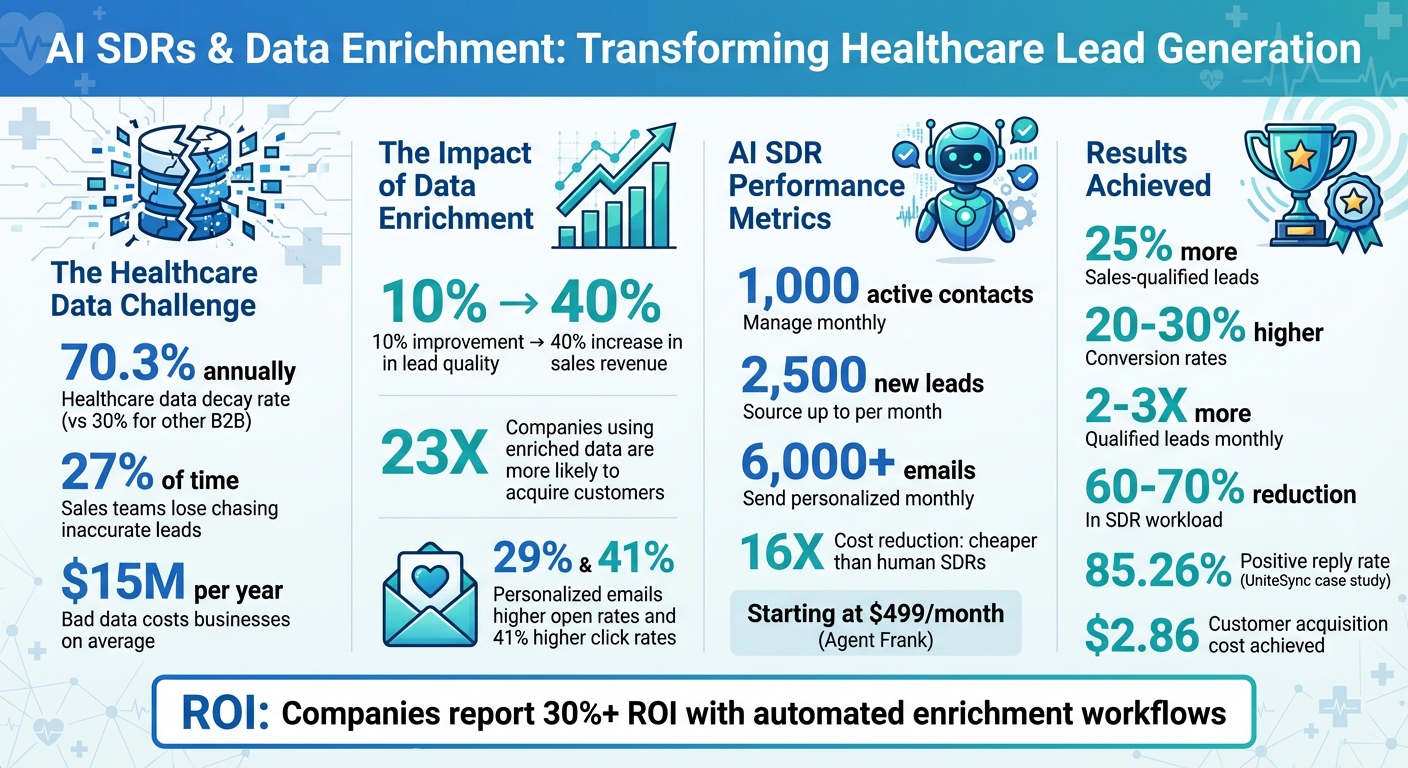
- Companies using these tools report up to 25% more sales-qualified leads, 20–30% higher conversions, and significant cost savings.
AI SDRs and Data Enrichment Impact on Healthcare Lead Generation
Why Healthcare Leads Need Data Enrichment
Healthcare lead data is notoriously fragmented. It involves a wide range of decision-makers - physicians, administrators, IT directors, and procurement specialists - whose contact details are often scattered across different systems. While most B2B data decays at a rate of 30% annually, healthcare data deteriorates even faster, with a staggering 70.3% decay rate.
This poor data quality has real consequences. Sales teams lose 27% of their time chasing inaccurate leads. Outdated information harms sender reputations and risks compliance violations. On the flip side, improving lead quality by just 10% can drive a 40% increase in sales revenue. In other words, accurate data isn’t just helpful - it directly impacts your bottom line.
Healthcare Lead Data Challenges
The healthcare industry faces unique challenges when it comes to lead data. Information is often siloed: one version of a contact might sit in your marketing platform, another in your CRM, and yet another in a sales team’s spreadsheet. This scattered data makes it nearly impossible to get a full picture of your prospects.
Incomplete profiles are another hurdle. Missing details like job roles, facility size, technology use, or budget authority leave teams guessing when it comes to personalization.
"Using first-party data that lacks context is akin to trying to put a puzzle together with half the pieces. It's hard to understand, difficult to act on, and won't provide complete insights that support informed decision-making".
Manual research compounds the problem. When sales development reps spend hours scouring LinkedIn, company websites, and news sources to piece together profiles, they lose valuable time that could be spent building relationships and closing deals.
How Enrichment Improves Lead Qualification
Data enrichment tools tackle these challenges head-on, automatically filling in missing details and verifying information. These tools validate critical contact details like email addresses and phone numbers in real time, ensuring your outreach reaches the right person. They also add firmographic data (e.g., company size, revenue, industry) and technographic insights (e.g., software and systems used by healthcare organizations), enabling precise and targeted pitches.
The results speak for themselves. Companies using enriched data are 23 times more likely to acquire customers. Take Darwinbox, for example. When they used Cognism to enrich their prospect database in 2025, they achieved over 90% accuracy for US data, improved their database quality by 10%, and added 15,000 US-based contacts.
Enriched data also allows for better personalization. Knowing details like a hospital’s recent funding, a new location, or a newly hired CIO can help craft icebreakers that resonate. Personalized emails perform significantly better, with 29% higher open rates and 41% higher click rates compared to generic outreach.
Beyond improving conversions, enriched data plays a critical role in meeting healthcare’s strict data privacy standards.
Meeting HIPAA and Healthcare Data Privacy Requirements
While enriched data improves lead qualification, it also ensures compliance with HIPAA’s stringent guidelines. Healthcare outreach comes with added complexity due to HIPAA compliance. Even though lead generation data typically doesn’t involve Protected Health Information (PHI), how you handle and share lead data must still adhere to healthcare privacy standards - especially when dealing with organizations that prioritize data security.
Data enrichment supports HIPAA compliance in several ways. First, it helps enforce the "minimum necessary" standard (§164.502(b)) by providing granular details about roles and departments, ensuring that only the right team members access specific lead data. Second, it helps identify whether a prospect qualifies as a "Business Associate", which is critical for ensuring proper agreements are in place before sharing sensitive data.
The 2025 updates to the HIPAA Security Rule introduced stricter requirements, replacing "addressable" specifications with mandatory safeguards like inventory management and access control. Enriched data supports these changes by enabling role-based access control (RBAC), ensuring sensitive information is only accessible to those who need it.
"Data accessibility and privacy don't need to be at odds when security is architected into the foundation of the EHR system... This supports secure, role-based access to ensure the right data is available to the right users at the right time".
Here’s how enriched data aligns with key HIPAA requirements:
| HIPAA Requirement | Role of Data Enrichment | Compliance Benefit |
|---|---|---|
| Minimum Necessary Rule | Identifies specific roles and departments | Prevents over-exposure of sensitive data |
| Business Associate Agreements | Identifies entity type and service relationship | Ensures legal agreements are in place before data sharing |
| Security Rule (Integrity) | Verifies and cleans outdated records | Reduces breaches caused by sending data to wrong recipients |
| Access Control | Enables role-based access | Limits data visibility to authorized personnel |
| Inventory Management | Tracks and categorizes CRM data | Meets 2025 documentation standards |
Before HIPAA standardization, healthcare fraud cost the industry $7 billion annually. Today, maintaining high-quality data isn’t just about sales efficiency - it’s about earning and keeping the trust of healthcare prospects who demand responsible data handling.
"The most successful customers are the ones that understand that a data strategy is not one-and-done... It's a cultural shift, and there are operational people, products, and processes put in place to maintain data quality, integrity, privacy on an ongoing basis".
How Agent Frank and AI SDRs Use Data Enrichment
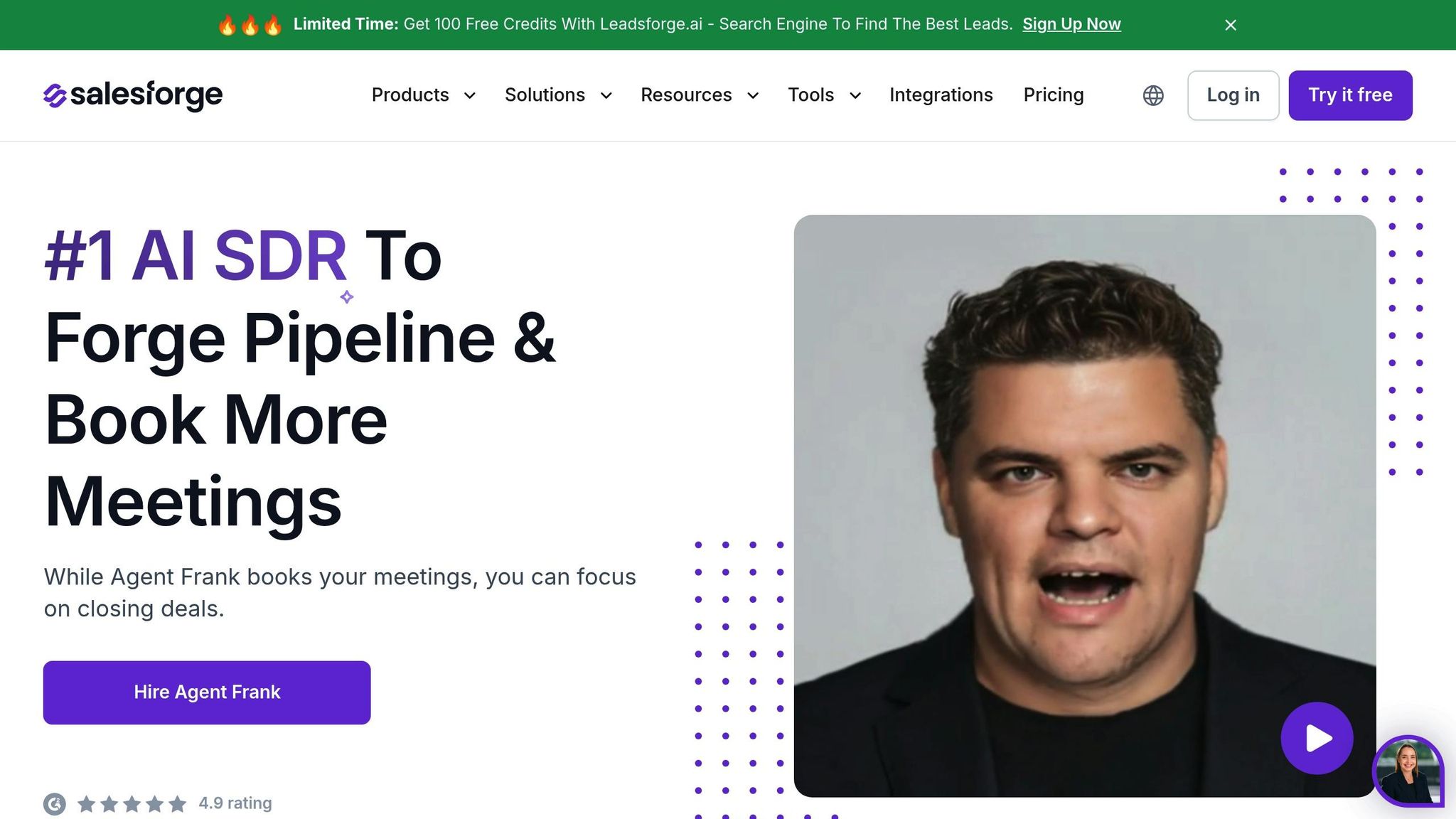
AI SDRs, like Agent Frank, take advantage of enriched data to streamline and supercharge the sales development process. From identifying prospects to scheduling meetings, these tools automate the entire workflow. Unlike human SDRs, who spend hours researching and crafting emails, Agent Frank processes vast amounts of enriched data at scale. It can manage 1,000 active contacts, source up to 2,500 new leads, and send over 6,000 personalized emails each month - all while cutting outbound costs by as much as 16×.
What sets AI SDRs apart is how they utilize enriched data. During the setup phase, users can upload healthcare product documentation, website links, and company details, creating a comprehensive knowledge base. This database powers every communication. Agent Frank even scans enriched prospect data - like LinkedIn posts and blog articles - to craft messages that resonate with healthcare executives. This ability to personalize outreach with precision lays the groundwork for exploring how Agent Frank automates data enrichment and email customization.
Automating Data Enrichment and Email Personalization
Agent Frank’s personalization engine seamlessly integrates data enrichment into its workflow. By selecting specific data sources - such as LinkedIn activity or blog posts - during setup, the platform can immediately tailor emails with relevant insights.
For instance, imagine a hospital CIO posts on LinkedIn about upgrading their EHR system. Agent Frank can reference this post directly in the email’s opening line, making the outreach feel timely and relevant.
"We are in rapid growth mode and needed tools to help us blitz scale our business quickly, efficiently and while maintaining our high level brand quality." – Ryan Van Hout, Partner & Co-Founder, VAI Consulting
With access to a database of over 500 million verified leads through Leadsforge, Agent Frank enriches data right at the prospecting stage. Once a qualified healthcare lead is identified, the platform pulls enriched data instantly, ensuring outreach begins without the typical lag between lead discovery and follow-up.
Prioritizing Leads with Intent Data
Enriched data becomes even more powerful when combined with intent signals - clues that a prospect is actively searching for solutions or tackling challenges your product can solve. Agent Frank analyzes profiles for high-intent signals specific to healthcare, such as funding announcements, new executive hires, changes in technology stacks, or regulatory deadlines. These signals trigger immediate updates to messaging and outreach sequences.
In 2025, AKOOL showcased this approach by scaling outreach to over 214,000 prospects using Salesforge's infrastructure. Their AI-powered campaigns, fueled by enriched data segmentation, achieved a positive reply rate of more than 16%. The secret? Using enriched data not only for personalization but also for smarter lead scoring and better sequence routing.
Coordinating Email and LinkedIn Outreach
Healthcare decision-makers are rarely swayed by a single touchpoint. Multiple interactions across different channels are often needed. AI SDRs use enriched data to create multi-channel sequences, combining email and LinkedIn outreach in a way that feels natural rather than overwhelming.
Agent Frank’s multi-channel tools ensure enriched data informs both email content and LinkedIn interactions, like connection requests or InMail messages. For example, if data suggests a prospect is highly active on LinkedIn, the AI prioritizes social engagement. On the other hand, if email appears to be their preferred mode of communication, the sequence leans more heavily on that channel.
The platform also allows for unlimited LinkedIn senders, enabling healthcare companies to scale their social selling efforts without worrying about account restrictions. Each LinkedIn touchpoint is enriched with specific, relevant details - such as a recent post about value-based care initiatives or attendance at a healthcare technology conference.
Before launching high-volume, multi-channel campaigns, it’s critical to warm up your email infrastructure for at least two weeks. This step ensures high deliverability rates and protects your sender reputation. Combined with enriched data for precise targeting, this warm-up period helps healthcare companies scale their outreach efforts effectively. These coordinated strategies demonstrate how AI SDRs like Agent Frank can transform data enrichment and outreach workflows for healthcare leads.
How to Set Up AI SDR and Data Enrichment Workflows
To make the most of enriched data for AI SDR performance, you need a well-structured workflow. Start by creating a solid infrastructure for email outreach. For healthcare campaigns, this involves configuring your email domains with DKIM, DMARC, and SPF records using tools like Infraforge or Mailforge. These settings help ensure your emails land in inboxes instead of being flagged as spam.
After setting up your infrastructure, run a two-week automated warmup process using Warmforge. This step gradually increases your email-sending volume, building trust with providers like Gmail and Outlook. Skipping this can harm your sender reputation, making it harder to reach potential leads.
Once your email setup is complete, configure Agent Frank by uploading healthcare-specific materials to its Knowledge Base. This step ensures the AI understands the medical context of your outreach. You’ll also set campaign goals, such as booking meetings, and select a tone for your messages - formal or professional tones tend to work best in healthcare. VAI Consulting used this approach during their growth phase and successfully booked three qualified sales calls in their first week.
Creating a Healthcare Lead Database
A strong lead database is the backbone of any outreach effort. Start by defining your ideal customer profile (ICP). Are you targeting hospital CIOs, practice managers, or medical directors? With Agent Frank’s built-in lead sourcing, you can access a database of over 500 million verified contacts through Leadsforge, filtering by job titles, company size, and healthcare specializations.
Maintaining accurate data from the beginning is critical. Up to 30% of customer data becomes outdated annually, leading to problems like invalid email addresses or incorrect job titles. Conduct monthly audits to prevent these issues, as bad data can cost businesses an average of $15 million a year. For healthcare companies, outdated information can also lead to compliance risks, further compounding financial losses.
When building your database, standardize data formats immediately. For example, use the MM/DD/YYYY format for dates to align with U.S. healthcare standards. Consistent formatting for addresses and other sensitive information ensures better data matching during enrichment and helps meet HIPAA compliance requirements.
Setting Up Automated Data Enrichment
Automated data enrichment keeps your system updated without requiring manual research. Agent Frank handles this by updating prospect profiles with information like LinkedIn activity, blog posts, and company updates. It can process 2,000–2,500 new leads per month while sending 6,000–7,500 personalized emails, a scale that would be impossible to manage manually.
When choosing enrichment tools, prioritize those with SOC 2, GDPR, and CCPA compliance to minimize legal risks, especially when dealing with healthcare data. For instance, UpLead offers highly verified emails with GDPR compliance, while Cognism provides human-verified global data. Agent Frank also meets GDPR and CCPA standards, ensuring legal compliance during automation.
Enrichment isn’t a one-and-done task - it should run continuously. As prospects engage with your content or change roles, your system should capture these updates. This keeps your outreach relevant, such as referencing a recent LinkedIn post about EHR upgrades instead of sending generic messages.
With automated enrichment in place, the next step is using this data to craft messages that feel personal and resonate with healthcare decision-makers.
Writing Personalized Messages with Enriched Data
Personalization is key to better outreach. Agent Frank uses enriched data - like recent LinkedIn posts or company news - to create messages that connect with healthcare executives.
The platform supports over 20 languages, making it ideal for healthcare organizations with international operations or diverse patient bases. You can tailor the tone to be professional or formal, ensuring your communication aligns with the standards expected in the healthcare industry. As Ryan Van Hout from VAI Consulting shared:
"We are in rapid growth mode and needed tools to help us blitz scale our business quickly, efficiently and while maintaining our high level brand quality."
To manage responses across multiple channels, use Primebox™ to consolidate replies from email and LinkedIn into one dashboard. This prevents leads from slipping through the cracks and helps your team respond faster. The AI prioritizes the most important conversations, which is critical when healthcare professionals expect prompt follow-ups.
| Step | Action Required | Tool/Feature |
|---|---|---|
| 1. Foundation | Set up domains, DKIM, DMARC, and SPF records | Infraforge / Mailforge |
| 2. Deliverability | Run a 2-week automated mailbox warmup | Warmforge |
| 3. Training | Upload healthcare materials to the Knowledge Base | Agent Frank Settings |
| 4. Execution | Set campaign goals (e.g., book meetings) and choose the tonality | Salesforge Dashboard |
Data Enrichment Providers for Healthcare Leads
Once your enrichment workflows are in place, the next step is finding a provider that aligns with healthcare standards. Picking the right provider can make or break your outreach efforts. A poor choice could leave you chasing outdated or irrelevant contacts, while a solid provider ensures accurate, compliant data that gets results. The healthcare sector demands providers who understand its unique requirements - strict compliance rules, niche job titles, and the need for real-time updates.
Top vendors in the field boast accuracy rates of 85–90% or higher. This level of precision is essential when targeting busy healthcare executives who expect up-to-date, relevant information. By adopting continuous, automated enrichment workflows supported by AI, organizations can see a return on investment (ROI) exceeding 30%. Such improvements directly enhance the efficiency of AI-powered SDRs (sales development representatives) and fine-tune outreach efforts. For example, Agent Frank can cut SDR costs by up to 16 times compared to human representatives, while Salesforge users have reported positive reply rates as high as 85.26% by leveraging enriched data and automated systems.
When choosing a provider, focus on three key criteria: compliance certifications (SOC 2, GDPR, CCPA), accuracy rates (anything below 85% could mean wasted time and effort), and seamless integration capabilities with your existing tools.
Provider Comparison Table
| Provider | Ideal For | Accuracy | Compliance | Key Healthcare Feature | Starting Cost |
|---|---|---|---|---|---|
| Leadsforge | Built-in AI SDR integration | 85–90%+ | GDPR, CCPA | – | $40/month |
| 11x AI | Autonomous SDR workflows | High | SOC 2, CASA 3 | Multi-source enrichment from 21+ sources | Custom pricing |
| ZoomInfo | Large enterprise databases | 90%+ | GDPR, CCPA | Healthcare-specific data fields | $599+/month |
| Cognism | Global healthcare outreach | 85%+ | GDPR, CCPA | Human-verified international data | Custom pricing |
| Definitive Healthcare | Healthcare-only focus | 90%+ | HIPAA-compliant | Hospital and provider-specific intelligence | Custom pricing |
For those looking for scalability, Agent Frank is available starting at $499/month for 1,000 active contacts. It includes access to Leadsforge's database, eliminating the need for an additional enrichment subscription. This streamlined integration not only reduces costs but also simplifies your tech stack. With these options, you can maintain the compliance, accuracy, and efficiency critical to successful healthcare campaigns.
Best Practices for Healthcare Outreach with AI SDRs
Making AI SDRs effective in healthcare requires a thoughtful approach that combines efficiency with accuracy. The healthcare sector has strict compliance standards and a discerning audience, so strategic planning is essential.
Maintaining Email Deliverability
Even the best-crafted message is useless if it doesn’t reach the inbox. Healthcare professionals are bombarded with emails daily, and landing in spam makes your outreach invisible. As mentioned earlier, setting up the right infrastructure - including a warm-up period and daily sending limits - is critical before launching campaigns.
Technical configurations play a big role in email success. Ensure that SPF, DKIM, DMARC, SSL, and domain masking are properly set up to verify your sender identity and protect your email reputation. For healthcare-specific outreach, private email infrastructures like Infraforge (starting at $33/month for 10 mailboxes) offer better control over IP reputation. Another option is Megaforge’s multi-ESP strategy (starting at $69/month for 20 mailboxes), which spreads your outreach across Gmail, Outlook, and private servers. This way, if one provider flags your emails, others can still deliver them.
"Cold email only works when it lands. That's where Salesforge and Mailforge have made the difference." - Carlos Palop Moliner, CEO at UniteSync
Keep track of your mailbox health regularly. Tools like Salesforge’s Heat Score™ help identify and pause underperforming or flagged accounts before they harm your entire campaign.
Once deliverability is under control, the next step is crafting outreach that feels personal and engaging.
Balancing Automation with Personal Touch
Automation shouldn’t feel robotic. Healthcare decision-makers can easily spot generic templates, and they’ll likely ignore them. The trick is using AI to handle repetitive tasks while preserving the human touch that builds trust.
Go beyond basic personalization like addressing someone by their first name. Use enriched data to reference specific pain points, such as challenges tied to the prospect’s facility type, recent initiatives, or regulatory changes affecting their role. Tools like Agent Frank can automatically gather this data and incorporate it into messages, making them feel tailored rather than mass-produced.
Your AI SDR should also adapt messaging based on recipient behavior. For instance, if someone opens your email multiple times but doesn’t reply, consider following up with a fresh angle or offering additional value. Keep messages conversational - use short paragraphs, clear language, and end with a single, straightforward call-to-action. This ensures even automated emails maintain a personal feel.
Once your outreach strikes the right tone, use performance data to fine-tune your efforts.
Using Performance Data to Improve Campaigns
After securing inbox placement and personalizing your outreach, the next step is to monitor and refine your campaigns. Data is only valuable if you act on it. The real strength of AI SDRs lies in their ability to continuously optimize based on what’s working.
Track key metrics like positive reply rate, meetings booked, and cost per acquisition (CAC). For example, in 2025, UniteSync used Salesforge to target music creators with unclaimed royalties. By monitoring deliverability and tailoring messages based on performance data, CEO Carlos Palop Moliner’s team achieved an impressive 85.26% positive reply rate and a $2.86 CAC. They reached this level of efficiency by testing subject lines, adjusting send times, and refining their value proposition based on real feedback.
Similarly, VAI Consulting saw success when Partner Ryan Van Hout used Agent Frank to drive business growth. By experimenting with different messaging strategies and monitoring performance data in real time, they consistently generated outbound leads while maintaining their brand’s quality.
Set aside time each week to review campaign data. Look for trends, such as which job titles respond most often, the best times to send emails, or the pain points that lead to the most meeting requests. Use these insights to tweak your targeting, refine your messaging, and pause underperforming segments. In the ever-changing healthcare landscape, constant optimization is the secret to staying ahead.
Measuring Success with AI SDRs and Data Enrichment
To make AI SDRs and data enrichment work effectively in healthcare, precise performance measurement is key. Instead of relying on vanity metrics, focus on data that shows real progress and results.
Key Performance Metrics
Start by examining engagement metrics to assess whether enriched data is improving your outreach. With AI-driven personalization, you should aim for email open rates of 20-40% and response rates of 15-20% when your enriched data is doing its job. These numbers reflect how well your targeting and messaging are connecting with your audience.
Next, dive into conversion metrics, which are directly tied to revenue. These metrics often show a 20–30% increase in lead-to-meeting rates. Pay attention to how many meetings lead to opportunities and, ultimately, closed deals. Given healthcare's notoriously long sales cycles, these metrics help determine whether your AI SDR is securing valuable, qualified meetings or just filling up calendars without real results. This step bridges day-to-day tactics with broader strategic goals.
Finally, evaluate the business impact. Calculate your cost per qualified meeting by dividing your AI SDR and enrichment expenses by the number of meetings booked. Compare this to the $8,000 per month cost of a traditional SDR. For ROI, use this formula: (revenue from booked meetings – tool costs) / tool costs. For example, Demandbase managed to double their pipeline generation in just one month while saving $80,000 in headcount costs by using AI SDR agents. These tools can automate 60-70% of SDR tasks, generating 2-3x more qualified leads monthly.
Metrics like these show how AI SDRs deliver measurable results in real-world scenarios.
Case Study: AI SDRs in Healthcare Outreach
Ryan Van Hout, a partner at VAI Consulting, successfully used Agent Frank to scale their business while maintaining high standards for brand quality and control over outbound leads. By combining AI automation with enriched healthcare data, they consistently secured qualified meetings without compromising personalization.
In one healthcare deployment, a medtech company targeting 5,000 clinic administrators achieved impressive engagement and conversion outcomes. By prioritizing leads with intent signals and tailoring emails based on enriched data - such as facility type and clinical specialty - they cut their SDR team’s workload by 70% and saw clear ROI growth. Agent Frank’s automated enrichment and personalization features also allowed them to track performance closely and refine their targeting, focusing on job titles and pain points that delivered the best results.
Conclusion
Healthcare lead generation faces hurdles like incomplete data, complex decision-making processes, lengthy sales cycles, and strict privacy regulations. However, integrating AI SDRs with data enrichment is changing the game. By automating prospecting, enhancing profiles with detailed firmographic and intent data, and scaling personalized outreach, healthcare sales teams can now see a 2–3x increase in qualified leads each month while reducing SDR workloads by up to 70%. Lead-to-opportunity conversions rise by 20–30%, allowing reps to spend more time on meaningful conversations instead of tedious tasks like data entry and follow-ups.
Real-world examples highlight the impact of AI SDRs. A mid-sized healthcare tech company reported a 30% boost in qualified leads and a 20% shorter sales cycle after adopting AI-driven SDR tools. These solutions go beyond task automation - they reshape how healthcare teams find, connect with, and convert prospects, all while staying compliant with HIPAA and privacy standards.
The numbers speak for themselves. Platforms like Salesforge, with tools such as Agent Frank, offer complete automation for the sales process. From lead generation and data enrichment to personalized outreach, email validation, multi-mailbox management, and meeting scheduling, these platforms streamline every step. For instance, Ryan Van Hout at VAI Consulting used Agent Frank to scale operations effectively, booking qualified meetings while maintaining brand integrity. Similarly, UniteSync achieved an 85.26% positive reply rate and a $2.86 customer acquisition cost by leveraging the Salesforge ecosystem.
The shift is undeniable: AI SDRs manage high-volume tasks, enriched data ensures precision, and human reps can focus on building relationships and closing deals. Teams that embrace this approach experience faster pipeline growth, higher conversion rates, and measurable ROI - all while navigating the unique challenges of compliance and data accuracy. This integrated strategy not only boosts efficiency but also strengthens engagement and ensures adherence to critical regulations.
Ready to transform healthcare lead generation? Check out Salesforge and deploy Agent Frank to combine AI SDRs with data enrichment for groundbreaking results in outbound sales.
FAQs
How do AI SDRs stay HIPAA-compliant when generating healthcare leads?
AI SDRs prioritize HIPAA compliance by strictly adhering to secure data handling practices and workflows. They focus solely on publicly available business information, such as company names, job titles, work emails, and phone numbers, while steering clear of any patient health information. Lead sourcing is restricted to HIPAA-approved data sources, and platforms enforce minimum necessary data collection, discarding any fields that might contain protected health information (PHI). All gathered data is encrypted and stored in secure systems that align with HIPAA standards, with team members undergoing ongoing compliance training to ensure best practices.
Salesforge’s Agent Frank incorporates these compliance measures directly into its AI-driven operations. Built on a secure, proprietary infrastructure, it isolates email traffic, utilizes warmed-up mailboxes, and enforces domain-level authentication. Agent Frank restricts data enrichment to non-PHI business details and ensures all prospect data is stored securely in an encrypted environment. This enables healthcare teams to confidently automate lead generation and outreach while leveraging AI-powered personalized messaging and seamless meeting scheduling - all while staying fully compliant.
How does data enrichment improve the quality of healthcare leads?
Data enrichment takes raw prospect information and enhances it with verified, up-to-date details such as contact information, areas of expertise, compliance data, and buying intent. By filling in critical gaps - like payer mix, recent procurement activity, or regulatory updates - this process turns vague records into actionable healthcare leads. It also adds valuable context, such as involvement in clinical trials or participation in recent mergers, allowing sales teams to target leads with a higher likelihood of conversion.
When paired with an AI-powered SDR like Salesforge’s Agent Frank, enriched data becomes even more powerful. It enables precise segmentation and hyper-personalized outreach. For instance, messages can be customized using accurate clinical terminology or by referencing recent hospital initiatives, aligning outreach with a prospect’s current priorities. This refined approach not only boosts engagement rates but also ensures sales teams focus their efforts on the most promising leads.
How do AI SDRs enhance personalized outreach in the healthcare industry?
AI-powered SDRs are transforming how personalized outreach is done in healthcare. By diving deep into prospect details - like job titles, previous interactions, and behavioral trends - they create customized messages that truly connect with each lead. This ensures every communication feels relevant and engaging.
They also handle follow-ups seamlessly, automating them with perfect timing and tailored content across platforms such as email and LinkedIn. This not only simplifies the outreach process but also sharpens lead qualification, increasing the likelihood of building strong relationships with healthcare professionals.
.png)